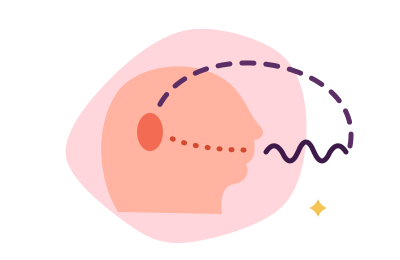
The recording is not broken, and neither are you. When you speak, you receive your voice through two channels at once: the air, like everyone else, and the bones and tissue of your own head, like no one else. Bone conducts the lower frequencies generously — which is why the voice in your skull is warmer, rounder and more authoritative than the one on the recording. Playback strips the bone channel away and hands you the air-only version: thinner, higher, a stranger wearing your sentences. Everyone else has been hearing that version all along, and — here is the consolation — they like it fine. It is the only you they know.
The shock is universal, and diagnostic of nothing
The wince at one's own playback is so common it has furniture in the psychology literature — voice confrontation, they call it. It afflicts broadcasters, singers and people who complain about microphones professionally. So the first manner to learn: disliking your recorded voice is not evidence that your mic sounds bad. The two feelings arrive on the same nerve, and untangling them is the beginning of all sensible audio troubleshooting.
What the shock is actually good for
Used correctly, the recording is the most honest instrument you own. It is what your colleagues, clients and loved ones receive; it is the ground truth the software chain keeps sending you back to. The manner is to listen past the stranger and audit the signal:
- Complaints about character — "too nasal", "too high", "is that really me" — are the bone channel's absence. Not fixable, not a fault. Every voice you have ever enjoyed on a call was its owner's air-only version too.
- Complaints about carriage — muffled, far away, too quiet, boomy, hissy, crackly — are the capture chain misbehaving, and each has a page and a fix in this house.
Read your own recording twice, once for each list. The character list you forgive — practice shrinks the wince, and nothing else needs doing. The carriage list you fix, symptom by symptom, with the checker as your escort.
A small etiquette exercise
Record thirty seconds of yourself reading something dull, wait an hour, and play it back while doing the dishes. Divided attention mutes the cringe circuit remarkably; you will hear the signal the way a stranger would — which is to say, the way everyone does. If it sounds like a person in a room speaking clearly: done, close the tab, go be audible. If it sounds like a person under a duvet, in a hall, or beside a frying pan, congratulations: you have a symptom, and symptoms are curable here.
The voice is yours either way. The manners are the microphone's. We only train the latter.
Further reading in the house: EQ for voice, for when the air-only version deserves a touch more warmth than the mic gives it — subtraction first, as always.